Tetsumi Kudo spent his early childhood in his father’s hometown of Aomori. Following his father’s premature death in 1945, Kudo moved to his mother’s hometown of Okayama, where he stayed until the end of high school. While attending Tokyo University of the Arts, Kudo showed his work in the Yomiuri Indepéndants Exhibition, an important platform for postwar avant-garde art, and, along with Ushio Shinohara and Shusaku Arakawa, became a prominent representative of the Anti-Art generation. In 1962, after being awarded the Grand Prize at the 2nd International Young Artists Exhibition, Kudo moved to France. With Paris as his base, he spent the next approximately 20 years developing a distinctive body of work that critically examined civilization through subjects such as the human body, sexuality, science, and social systems.
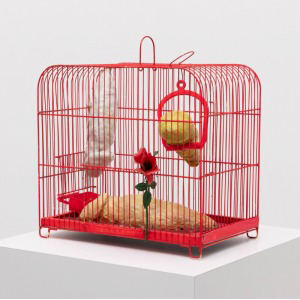
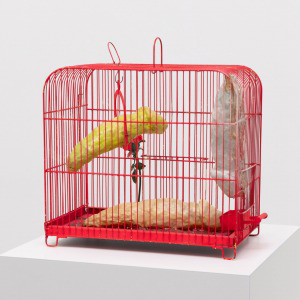
In 1965, three years after moving to France, Kudo’s first solo show in Paris was organized by the art critic Pierre Restany at Galerie J. It was also around this time that he began to develop in earnest the birdcage series to which the present work, For Your Living Room – For Nostalgic Purpose (1965), belongs. Kudo called the birdcage “a box full of cracks.” As he wrote, “We couldn't live without boxes. We come from a box (uterus), grow up in a box (apartment), and are put inside a box (coffin) when we die. From the time that we're born until we die, we create our own box for ourselves.”¹ Based on this idea, the birdcage can be seen not simply as a container for confinement, but as a small model of society—a device for human observation in which the condition of human beings is placed on display.
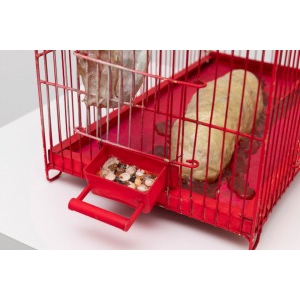
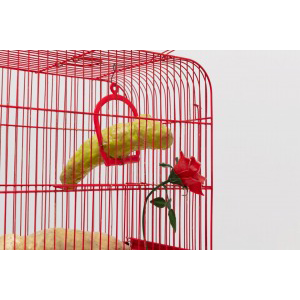
Within the cage, a phallic form rests on a perch like a small bird, while another is placed below in a pose suggestive of a guinea pig. Kudo regarded the penis as “extremely artificial and comical, both in terms of its visual and its functional meaning,” and believed that nothing symbolized the breakdown of “human dignity” more clearly than a male sex organ separated from the human body. Here again, Kudo’s own words are revealing: “When I think about freedom or rebellion, I think of guinea pigs. Guinea pigs begging for food in their cages, reacting to temperature and chemicals. We are all guinea pigs whose uses have been determined in advance, appropriately manipulated, mass-produced guinea pigs.”² Human beings, who imagine themselves to be living freely, are in reality managed—or, one might say, bred—by social structures and institutions, and conditioned by them. The strange and faintly comic scene presented in this work may thus be seen as reflecting the condition of modern humanity. By contrast, the red rose placed outside the cage conventionally evokes love and beauty, creating a vivid counterpoint to the enclosed world within.
Kudo described himself not simply as a “painter,” but as a “journalist.” For him, works were “material for thought” or “models of social criticism,” intended to prompt the viewer to think. When we look into the birdcage in the present work, what is it that is actually confined within it: a strange creature, or ourselves, living within systems of desire and society? Through a scene that is at once humorous and unsettling, Kudo poses this question directly to the viewer.
Footnotes:
¹ Tetsumi Kudo, “Box,” 1976. Written for the catalogue of his solo exhibition at Galerie Beaubourg and Galerie Vallois, Paris, 1977. Quoted from Your Portrait: Tetsumi Kudo Retrospective, p. 120.
² Quoted from TETSUMI KUDO: Contestation/Création, p. 14.
Bibliography:
The National Museum of Art, Osaka, ed., TETSUMI KUDO: Contestation/Création, exhibition catalogue, The National Museum of Art, Osaka, 1994
Atsuhiko Shima et al., eds., Your Portrait: Tetsumi Kudo Retrospective, exhibition catalogue, The National Museum of Art, Osaka and Daikin Foundation for Contemporary Arts, 2013