Literature:
"Gerhard Richter Bilder Paintings 1962-1985" DuMont Buchverlag Köln, 1986, P. 148, No. 325/1-120 (illustrated as part of the complete work)
"Gerhard Richter: Werkübersicht/Catalogue Raisonné 1962-1993, Volume III" Kunst- und Ausstellungshalle der Bundesrepublik Deutschland, Cantz Verlag, 1993, No. 325/1-120 (illustrated as part of the complete work)
"Gerhard Richter: Catalogue Raisonné, 1968-1976, Volume 2" Dietmar Elger, Hatje Cantz, 2017, P. 454 – 455, No. 325/1-120 (illustrated as part of the complete work)
Gerhard Richter first came to widespread attention through his Photo Paintings, which he began in the early 1960s. From the mid-1960s onward, through such bodies of work as the Colour Charts and Grey Paintings, he began to reconsider established notions of painting in which color and form were shaped by the artist’s subjective vision.
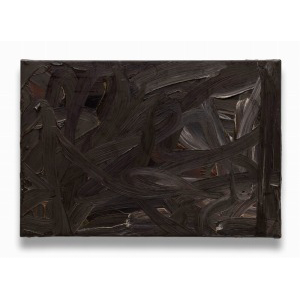
Vermalung (Braun), 1972, is part of a series of Vermalung, or Inpainting, works developed between 1971 and 1973. For Vermalung (Braun), Richter arranged 120 canvases, each measuring 27 × 40 cm, to form a single large pictorial field. He painted across the assembled canvases as a unified whole (figs. 1, 2), before separating them into 120 unique works that were subsequently sold individually.
In the present work, elongated traces of brown paint overlap in successive layers, creating a complex and dynamic pictorial surface. The painterly gestures characteristic of the Vermalung works were not intended as expressions of personal emotion or inner life; rather, the image takes shape through the act of painting itself. In this respect, the series can be understood as reflecting Richter’s critical engagement with Abstract Expressionism, which, from the 1950s onward, placed particular emphasis on the artist’s bodily gesture and brushwork as expressions of individual emotion and artistic originality.
Through the act of dividing a single large composition, each individual canvas remains part of the original work while simultaneously existing as a complete work in its own right. In this way, even a fragment of a larger whole can be viewed as an independent work. At the same time, this structure raises the question of where the “originality” of an artwork resides.
This practice developed from Vermalung (Grau) of 1971 through the present Vermalung (Braun) and into Rot-Blau-Gelb of 1973, leading to Richter’s Abstract Paintings, which became a major strand of his work from the latter half of the 1970s onward.
Through the movement of paint and the act of painting, Vermalung (Braun) reconsiders the relationship between artistic intention and the formation of the pictorial surface. Situated at a transitional moment in Richter’s development, the work marks a passage toward his Abstract Paintings.
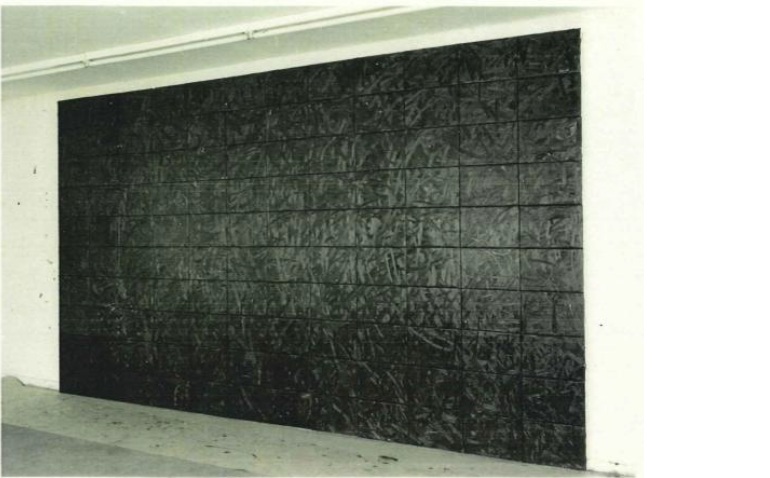
fig. 1《Vermalung/Inpainting》
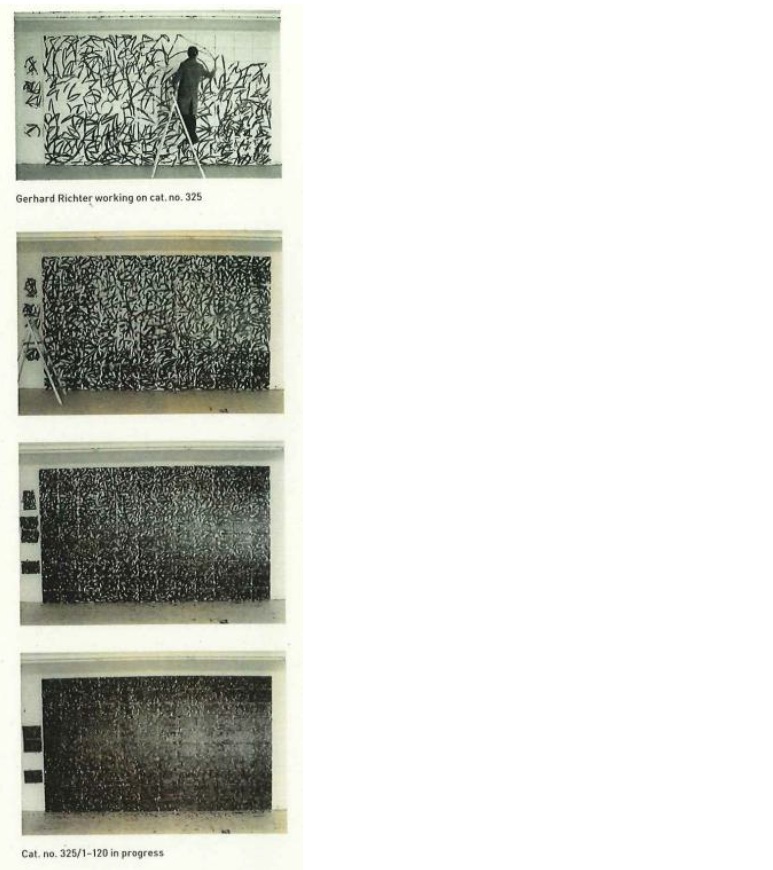
fig. 2《Vermalung/Inpainting》
fig. 1–2: Dietmar Elger, Gerhard Richter: Catalogue Raisonné, 1968–1976, Volume 2, Hatje Cantz, 2017, P. 454 – 455, No. 325/1-120